AIoT Starts With Data Streaming
What happens when AI stops learning only from content and starts learning from the physical world in real time?
We spoke with Barry Libert, CEO and Chairman of HiveMQ about the impact of AI on IoT. Barry Libert was brought in to lead a strategic shift positioning HiveMQ as an Industrial AI Platform after a successful career as a ‘Unicorn Builder’ with various technology companies across the USA, EU and UK. He is also a long-time board member, operating partner, and author/commentator on technology-driven business model change.
He says that the conclusion is direct. AI becomes significantly more powerful when it is grounded in real-world data. And IoT is what provides that ground truth.
AIoT Is Not a Future Concept
AIoT – the convergence of artificial intelligence and the Internet of Things – is often positioned as something on the horizon. In this conversation, it is treated as something already underway.
Most AI models today are built on written, visual, and audio content. That has driven rapid progress, but it only captures part of the available data. A far larger volume exists in the physical world, generated continuously by devices, machines, and environments.
If that data is captured and used, AI shifts from interpreting the world to observing it directly.
Libert does not see IoT and AI as separate domains that need integrating. In his view, they are already merging. The more useful way to think about this is as a single system where devices, data, and intelligence operate together.
Why Data Streaming Sits at the Centre

At the core of that system is data streaming.
Before intelligence or automation is possible, there must be continuous movement of data between devices, systems, and the cloud. Without that flow, AI lacks real-time context and cannot operate effectively.
This marks a shift away from traditional architectures that collect data, store it, and analyse it later. In an AIoT model, data moves continuously. Systems can detect changes as they happen and respond in the moment.
As Libert describes it, this creates a progression. First, data flows across devices and environments. Then models are built at the edge and in the cloud. Those models generate insights, and over time those insights feed back into operations. The result is not just better understanding, but the ability to act.
This is where IoT feeds AI in a meaningful way. It provides the signals and state changes that anchor intelligence in reality.
For a deeper look at how this plays out at the edge, see why an AI approach to IoT starts at the edge, not the cloud.
From Visibility to Autonomous Action
Much of the current focus in AI is on visibility. Better dashboards, better reporting, better decision support. That is part of the story, but it is not the end state.
In an AIoT system, the goal is not just to see what is happening. It is to respond to it.
Libert describes a model where machines receive signals, adjust their behaviour, and communicate with other systems in real time. A device can detect that it is likely to fail and trigger maintenance before downtime occurs. It can signal upstream systems to prepare replacements or downstream systems to adapt operations.
These capabilities are already emerging. What is changing is how widely they can be applied. When data streaming, AI models, and connected devices are brought together, those responses can happen continuously and across entire operations.
That is where productivity gains begin to scale. Instead of reacting after the fact, systems move toward anticipating and preventing issues.
The Role of the ‘Enterprise Brain’
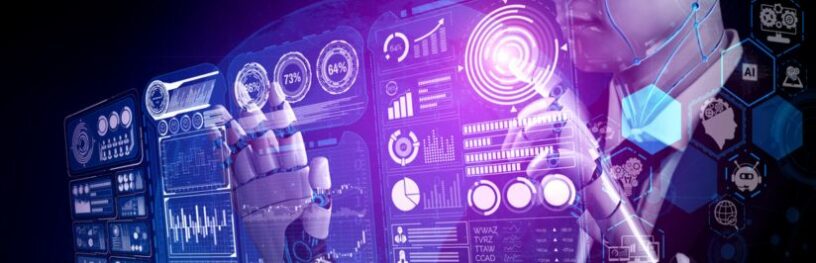
This emerging capability can be described as an ‘enterprise brain’, as mentioned in our previous episode with Rob Tiffany, “Building the Enterprise Brain with AI, IoT, and Private Data”. A unified, real-time view of how a business operates.
Libert connects this to the idea of ontology: a structured model of how devices, people, processes, and data flows relate to one another. While the terminology varies, the intent is the same. It is about understanding operations as a connected system rather than a set of isolated functions.
Traditional enterprise software tends to mirror organizational structures. It reflects departments, workflows, and reporting lines. An ontology reflects something different. It maps how work happens, showing dependencies, bottlenecks, and interactions as they unfold.
Take healthcare as an example. By connecting patients, staff, and devices, it became clear that delays were not occurring in treatment itself, but in downstream processes like pharmacy fulfilment. Without that connected view, the problem remained hidden.
With it, organizations can begin to optimize processes in ways that were previously impossible.
This thinking aligns closely with the idea of building an enterprise-wide intelligence layer, as explored in what is an enterprise brain and why AI needs IoT data to build it.
Why Enterprise Software Is Being Rewritten by AI
This shift has direct implications for enterprise software, such as recent pressure on traditional software companies as AI capabilities expand. The underlying issue is that businesses can now create operational layers more quickly and at lower cost than before.
Libert frames this as a familiar pattern. New technologies consistently reshape the models that came before them. Just as cloud computing disrupted on-premises software, AI is beginning to challenge the assumptions behind SaaS.
The expectation is changing. Organizations are no longer looking only for systems that manage workflows or store data. They want systems that can interpret information, generate insights, and drive outcomes.
That increases the importance of IoT data. Without real-world inputs, AI systems struggle to deliver meaningful operational value. With it, they become far more relevant to how businesses run.
Artificial Humans and the Changing Role of Work

One of Libert’s more striking ideas a description of AI systems as ‘artificial humans’.
The point is not rhetorical. It is a way of reframing AI as something that participates in work, rather than something that simply supports it.
These systems can already perform many knowledge-based tasks at speed and scale. They generate content, write code, analyse information, and increasingly interact with other systems. In some cases, they operate with minimal oversight.
That raises an immediate question about the role of humans.
Libert’s answer centres on framing. The value of human contribution shifts toward asking better questions, defining direction, and deciding what problems matter. This is less about producing outputs and more about guiding systems effectively.
Will the pace of change be faster than the labour market can absorb? Graduates are entering a world where many entry-level tasks are already being automated, and the pathway to new roles is not yet clear.
There is a suggestion that new forms of work will emerge around managing, directing, and collaborating with these systems. The challenge is how quickly organizations and individuals can adapt.
This also connects to broader questions about how AI is being used inside organizations, often without clear oversight, as explored in shadow AI in business.
The Direction of Travel
Organisations are moving toward models built on continuous data flows, where IoT provides real-time visibility and AI turns that visibility into action. As those systems mature, they become more structured, more connected, and increasingly capable of operating with a degree of autonomy.
This is why the convergence of IoT and AI matters. IoT provides the data that reflects what is actually happening. AI provides the ability to interpret and act on that data.
Together, they create a new operational model. One where systems do not just report on the business but actively shape how it runs.
For leaders, the implication is clearly that treating IoT and AI as separate initiatives misses the point. The value comes from how they work together, and how quickly that combined capability can be embedded into operations.
That shift is already underway. The question is how quickly organizations move to meet it.